Expectations, Great Expectations

Expectations, Great Expectations

I was a new bride, newly pregnant, when my mom-in-law brought me some chaat. As we sat eating, she kept looking at me, almost expectantly. I could sense her disappointment but couldn’t quite understand why.

Now, 36 years later, I think I do.

I could have thanked her for being so thoughtful. I could have told her how delicious the chaat was, how much I was enjoying it. But my blissfully oblivious younger self simply didn’t think to say any of it.

I was enjoying the chaat. She was waiting to hear that I was. And somewhere between my unspoken pleasure and her unfulfilled expectation lay a small disappointment. One that has stayed with me for 36 years.

*

Most disappointments, I have come to realize, begin with an expectation.

It is when we expect that we are disappointed.

A simple enough truth. One we all know and yet spend an entire lifetime failing to learn.

We continue to expect.

We expect affection, attention, consideration. Gratitude for what we give, appreciation for what we do, and love in return for the love we offer.

We write little scripts for the people in our lives. What they should say. How they should respond. What they should remember. How they should make us feel.

And when they fail to follow the script, we feel hurt, neglected, sometimes even unloved. We mistake the absence of expression for evidence that we matter less than we believed. But instead of speaking up, we swallow the disappointment and carry on. Or so we think.

For disappointments have a way of quietly accumulating.

Somewhere in our minds, we begin to keep account. Entries are made. Balances calculated. Debts accumulated. And one day, something quite insignificant becomes the final entry.

A forgotten birthday. An unanswered message. An invitation that never came.

And suddenly, years of accumulated disappointment come tumbling out.

We lash out. We accuse. We withdraw. We revisit old wounds and summon forgotten grievances. A small moment becomes a battlefield.

The anger eventually subsides, but the damage remains. Our dignity compromised. Our relationships bruised. Words spoken that cannot be taken back.

An expectation became a disappointment. The disappointment became resentment. And the resentment robbed us of something far more precious than whatever we had hoped to receive.

Our peace.

All because life did not unfold according to a script written entirely in our own heads.

And that, perhaps, is the great tragedy of expectations.

*

But then, is it really possible to live without expectations? Expectations, after all, are woven into the fabric of our relationships. They are part of what makes us human.

Perhaps the answer is not to give up expectations, but to learn to live with them differently.

We expect others to love us in our language, forgetting that they may be speaking an entirely different one. We forget that they are not us. They carry different histories, different insecurities, different ways of expressing and receiving love.

Perhaps we need to be a little less certain that our way is the only way. A little more generous in our interpretations of others. A little less quick to feel slighted.

To recognize that not every omission is an insult. Not every silence is indifference. Not every unmet expectation is a measure of how little we matter.

And perhaps, most importantly, to stop expecting people to read our minds. For how can we hold someone responsible for failing to fulfil an expectation they never knew existed?

Perhaps we cannot live without expectations. But we can learn to hold them a little more lightly.

To say what we feel. To express what matters to us. To ask for what we need rather than quietly resenting its absence. And when expectations go unmet, to forgive a little more generously.

And sometimes, simply to let go.

*

I think back to that afternoon, 36 years ago.

Perhaps I could have been a little more thoughtful, a little more expressive. And perhaps my mom-in-law could simply have asked whether I was enjoying the chaat. I would have happily told her that I was. Very much so. A few words might have made all the difference.

And perhaps this is what life teaches us, slowly, over the years. To expect a little less, understand a little more, and be grateful for what is already there.

For when we loosen our hold on what we expected, we begin to appreciate what we have been given.

Everyday, Again

Everyday, Again

Every morning, my alarm rings at 5:45 a.m.
Monday to Friday. Without negotiation.

And just like that, the day begins.

A familiar sequence unfolds — the walk, the newspaper, breakfast, work, lunch, more work, dinner, a little television, sleep. Alarm. Again. And life hums along in a rhythm so predictable that we barely notice it anymore.

The weekend arrives like a soft breeze — light, liberating, promising freedom. And just as quietly, it slips away. By Sunday evening, Monday is already knocking, carrying with it structure, responsibility, and the weight of having to show up again.

Days blur into weeks, weeks into months, months into years. And somewhere in this steady flow, life keeps moving — leaving us caught between who we want to be and who we must be.

And what do we long for?

The spark of something new. Unplanned trips. Impulsive decisions. Late-night laughter and midnight malts. A life led by desire rather than duty. A life where mornings feel like paintings and evenings read like poetry.

And in this hopeful pursuit of the extraordinary, we dismiss the life we already have. We call it ordinary. Boring. Routine. We grow impatient, irritable, restless — convinced that our real life is waiting somewhere else.

Routine, after all, isn’t glamorous. It looks like the same breakfast, the same walk, the same conversations. It feels unremarkable — as if life is on a continuous repeat.

And yet…

Why is it that we ache for routine precisely when it disappears?

A few days away from home, and we begin to miss our 6:30 a.m. cup of tea. That quiet, focused hour of work. The comfort of an early night. Even the most beautiful destinations slowly lose their charm. And after retirement, many of us find ourselves longing for the days when there was no time to think at all — when life moved us forward without asking too many questions.

So what is routine really giving us, that we only understand once it’s gone?

I found my answer looking out from a hospital window.

Outside, life was unfolding as usual. People rushing to work, arguing into their phones, buying fruits, laughing, hurrying somewhere important. In their utterly unremarkable busyness was an unexpected comfort: the quiet assurance that all was well. That their lives were moving as they should — without alarm, without worry, without urgency.

And that’s when it struck me.

Routine is not monotony.
It is evidence that things are fundamentally okay.

It means the world is not on fire.
Children are healthy. Parents are well. Relationships are steady. Life is quietly holding together.

Routine doesn’t just organize our days. It anchors us. It gives us direction. It gives us the space to plan, to hope, to dream — and to build anything meaningful: a career, a relationship, a life. It isn’t stagnation; it’s movement without panic. Progress without noise.

So the next time you catch yourself thinking, “Nothing special today,” pause. Nothing dramatic is happening. And that — quietly, beautifully — is what makes the day special. It allows us to trust in another tomorrow.

True, routine is simply okay.
And okay, I’ve learned, is a beautiful place to be.

I, Me, Myself

I, Me, Myself

Who would have imagined that a week that began with a doctor – who, with the precision of a prosecutor, laid out all the terrible things I’d been doing to my body for decades – could end up being, of all things, rewarding? And yet somehow, after the tidal wave of alarm and self-recrimination had passed, it actually was.

A week of detox at a wellness retreat tucked deep inside the forest in the remote hills of Uttarakhand. Just me and my husband Atul, and seven whole days of hot massages, green juices, and well-meaning strangers reminding us to breathe deeply.

And I have to admit, I can’t quite figure out why we didn’t do this sooner. Really, I can’t. Was it because we were so busy with the usual business of life? Or was it because we’d always thought of holidays as time to see new places, buy shoes, and let the kids have fun? And honestly, wasn’t detox something for other people? You know, the ones with bad knees and high cholesterol? Or… maybe it was because we’d always dismissed these retreats as glorified getaways for people with too much money and not enough sense. Whatever the reason, we were wrong. About everything. Every last thing.

So, finally—after being married for thirty-five years, after raising and marrying off two children, and after spending hours debating and rejecting every possible winter vacation destination on the planet—we did it. And here we were. Finally.

*

The first thing we noticed was the Quiet. Yes, with a capital Q. The stillness of the dense lush forest seemed to seep into us. It was divine. Sacred. People spoke in hushed tones, their movements slow and deliberate, as if unwilling to disturb nature’s rhythm. It was like stepping into an alternate universe where silence wasn’t just the absence of sound but a presence in its own right. I couldn’t remember the last time I’d felt so utterly, completely at peace.

Life, for once, hit the pause button. And stayed there. The days stretched lazily before us: long walks down winding paths that seemed to go nowhere, indulgent massages that seemed to unlock every single knot of tension I’d been carrying since I could remember, and a menu of therapies that looked like something out of a dream journal. Yoga. Meditation. Gardening. And the pièce de résistance? Guilt-free sleep for long, unhurried hours. It was like living inside a self-help bestseller, except that I didn’t need to underline a single thing. By the second day, we were fully converted. Life, it seemed, was all about rest, renewal, and rejuvenation. And we had finally learned how to indulge in all three.

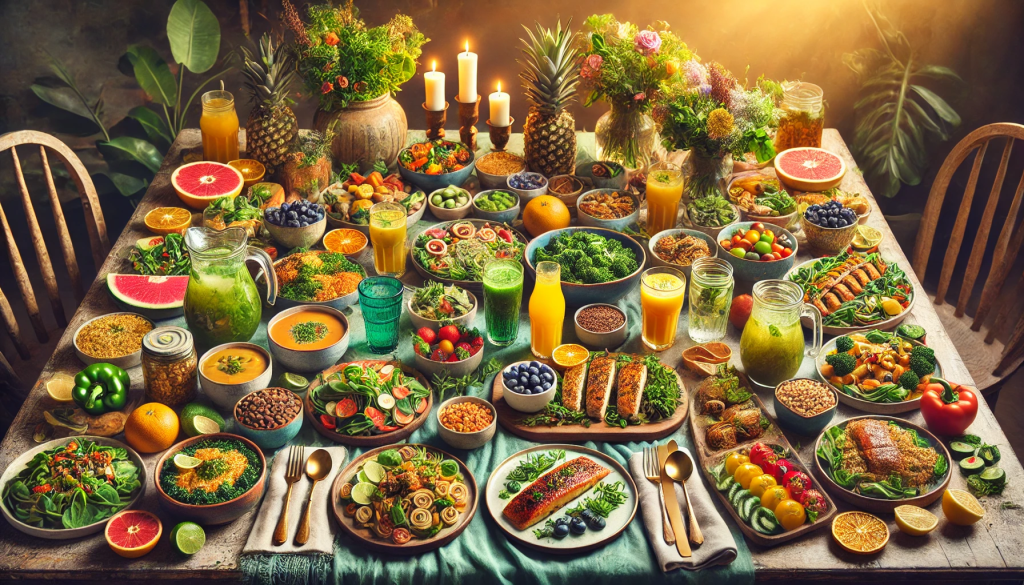
And then there was the food. Infuriatingly good food. Not the kind of good that makes you want seconds but the kind of good that makes you wonder why you haven’t been eating this way your entire life. Everything was fresh, filling, and annoyingly virtuous—salads so vibrant, broths so delicate, and desserts that tasted better than anything I’d ever eaten — despite containing absolutely no sugar. It wasn’t deprivation; it was discovery.

But here’s the thing—the real revelation wasn’t in the food or the deep breathing or even the quiet. It was the unloading of the stress. Stress we’d been hauling around, both of us, for so long we’d forgotten what it felt like to be rid of it. And somewhere between the Ayurvedic massages, the green smoothies, and the gentle meditation sessions, that stress began to dissolve. I knew it was gone when Atul burst out laughing when he was served rolled-up pineapple presented as stuffed cannoli dessert… and laughed and laughed, the belly-deep laugh I hadn’t heard from him in years. That’s when I knew we’d found the magic.

By the end of the week, I wasn’t just detoxed. I was transformed. Lighter, freer, calmer—and dare I say it, kinder to myself. Because sometimes, all you really need is the quiet of a forest, the space to breathe, and enough time to forget about the chaos around—and inside—of you. Perhaps most importantly, I learned to listen to my body, which had been screaming at me for years, and finally figured out what it had been trying to tell me all along.

Sometime during that week, I realized the sheer brilliance of putting myself first. Not in a narcissistic, self-absorbed way, but in a way that gives me permission to pause and think about what I, as an individual, want. My own desires. My own thoughts. My own well-being. It sounds so new, so revolutionary—and yet, somehow, it feels like the most obvious thing in the world. Like discovering a secret that had been sitting right there, quietly waiting for me to notice it. Which, of course, I did, while sipping herbal tea and wearing a white kurta-pyjama!

*

This coming New Year, I’ve made a resolution. It’s not about losing weight or achieving targets or tackling the endless to-do list. It’s about I, Me, Myself. Not in the selfish, “ignore the world” sense—but in the “finally take center stage in my own life” sense. And I can’t wait to see how much brighter everything looks from here.