I am sure the universe knows exactly what it’s doing when it brings people together. It rarely pairs like with like. More often, it brings opposites into the same orbit — people different in a hundred small ways, who, somehow, make perfect sense side by side.
Take my husband and me.
I like to share. Everything. What I did. What I didn’t. Who I met, what they said, what they didn’t (but clearly meant).
The blog I’m writing. The butcher who messed up my order. The stray dogs in the colony. The cook who staged yet another dramatic exit. The cousin whose cousin is now somewhat famous…
And him?
He’s a man of few words. But many nods.
Let’s be clear — these aren’t the tender, attentive, “yes, my dear, I agree” kind of nods. These are the absent-minded, default nods — dispensed while checking emails, reading the news, or scrolling through WhatsApp groups.
Over the years, we’ve settled into a rhythm. I talk. He nods. I throw up my hands in mock exasperation. And then — eventually — he looks up. Fully present. Curious. As if hearing it all for the very first time.
*
It’s not perfect. And yet — there’s something oddly comforting in this dance of words and nods.
Because I understand where his mind is… It’s somewhere between a delayed shipment at customs, a lost pitch, the latest dip in stock prices… and a hundred other quiet battles he fights daily.
And still — his nods, even if distracted, tell me something. That my words have landed. Somewhere. Softly. In that busy, burdened, but deeply dependable heart.
It’s hard to explain. It’s not logical. But in those simple nods, I hear this:
“I know you need to say it.” “I know it matters to you, even if it doesn’t matter to the world.” “I trust your instincts, even if I missed the details.” “And I’ll always be here, nodding along — because I love how your mind works, even if I can’t always follow where it’s going.”
It’s his way of showing up — with a nod. The smallest, quietest act of partnership.
(Though at times, he does surprise me. Like the time he suggested we holiday in Bruges — something I must have mentioned, sometime, somewhere. He had remembered. Even if I’d forgotten I had said it.)
*
So here we are. All these years later.
Me, still talking. Him, still nodding.
A marriage where one partner needs to speak — and the other gently makes space for it. And in these little spaces between our words and nods, we’ve built something whole.
Valentine’s Day arrives, and love steps into the spotlight. Everything – yes, everything -from balloons and chocolates to cupcakes and even pizza, is suddenly heart-shaped. And for one full day (at least), love feels magical.
*
This year, like every year, Valentine’s Day left me grappling with the eternal question: What is love, really? Is it a sudden jolt, like lightning out of a clear sky, which leaves you breathless, dizzy, and utterly bewitched?
And then I wonder: Did I ever fall in love?
I’ve been married for 35 years to a man my parents introduced me to. Before I even saw him, I heard his voice – deep, confident, reassuring. Our first meeting was a blur of conversation; we talked nonstop, swapping stories, dreams, and laughter. One meeting became two, then three, families gathered, wedding plans took shape, and just like that, we were married. Decades later, here we are – still together, still devoted, still finding joy in everything we share (touchwood!).
Our children, though, “fell” in love in the classic sense, full of drama, excitement, and movie-type romance. When they describe love, it sounds like fireworks and magic – something grand and dizzying. And I can’t help wondering: What makes their love different from ours?
Sure, in our case, there was no chase, no drama, no stolen glances across crowded rooms. No love-struck confessions, no candlelit dinners, no carefully planned surprises or perfectly chosen gifts. But then, we dated with the quiet confidence of commitment. And like any young couple, we looked forward to being together, savoring every moment, counting down the days until marriage would seal our togetherness.
So maybe the real question isn’t What is love? but rather Why do we believe it only counts when it comes with fireworks?
*
After thinking it through for many, many years, I have come to the conclusion: It is not about falling in love – it is about being in love.
So what if our relationship began with mutual respect, appreciation, and commitment instead of a whirlwind romance? So what if it was a path of discovery, deepening over time through shared experiences? So what if it started with uncertainty and blossomed into something steady and enduring?
Arranged or not, love has a way of finding you. It sneaks up quietly, weaving itself through the fabric of everyday life – shared cups of tea at dawn, laughter over dinner, the chaos of raising children, and the resilience through life’s storms. It doesn’t arrive with grand gestures but settles in through small, unremarkable acts of kindness, patience, and unwavering warmth – until one day, you realize those ordinary moments are everything. Love isn’t just a feeling; it’s a sense of home – not in a place, but in a person. And it is in the years after marriage that love truly comes into its own, evolving into something deeper, something real.
For my husband and me, love has been a journey – one that, decades later, has brought us to a place where words are often unnecessary. It’s the quiet accumulation of a thousand little moments that, together, create something profound. It’s knowing each other’s quirks and embracing them, arguing without truly wounding, forgiving without keeping score.
It’s waking up every morning and instinctively reaching for his hand. It’s sharing inside jokes no one else would understand, reminiscing about past adventures while mapping out new ones, sitting through his favorite shows even when I can’t stand them. It’s reading in the same room in comfortable silence. It’s letting him have the last bite of dessert because I know he wants it but will still leave it for me.
In the end, it doesn’t matter how love begins—what matters is how it grows. It’s simply knowing, deep down, that life makes more sense with the other person in it.
*
So no, I didn’t fall in love in a grand, dramatic way – but love found me anyway, quietly and steadily, like sunlight creeping into a room, soft and unassuming, until one day I looked around and realized everything was glowing.
And after 35 years, that feels more romantic than anything else.
In India, marrying off a child is not just a milestone; it’s the mission of a lifetime. Parents begin anticipating this event the moment they hear their baby’s first cry. And when the time comes, they will do anything – beg, borrow or (metaphorically) steal – to make the wedding nothing short of legendary.
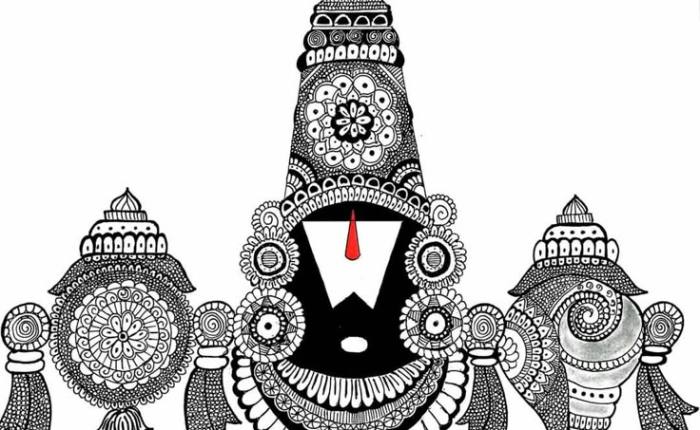
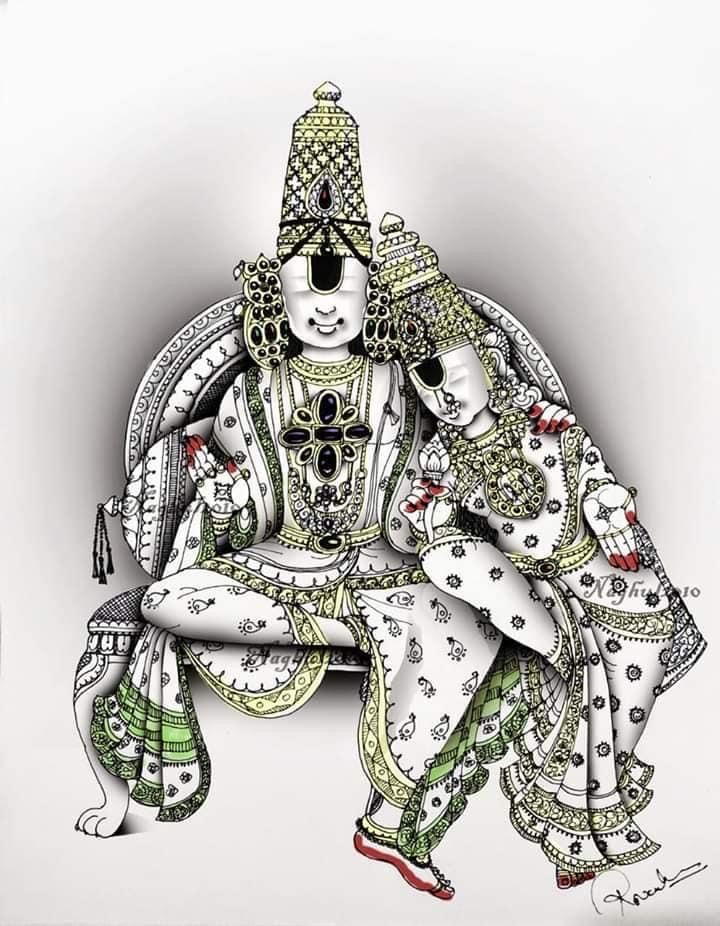
Even the gods are not spared. Take, for instance, the love story of Lord Venkateshvara and Padmavati which culminated in a wedding so grand, so sacred, that it continues to be celebrated every single day at the Tirupati temple in the Tirumala hills of Andhra Pradesh.
And guess what? The budget for this wedding was so extravagant that Lord Venkateshvara – the Preserver of the Universe – had to take a loan from Kuber, the treasurer of the Gods!
But how did this come about? I heard this fascinating tale on my recent trip to Tirupati…
*
Long ago, in his celestial abode of Vaikunth, Lord Vishnu sat in deep meditation, completely immersed in his divine state. Which is why he failed to register the arrival of the great sage Bhrigu.
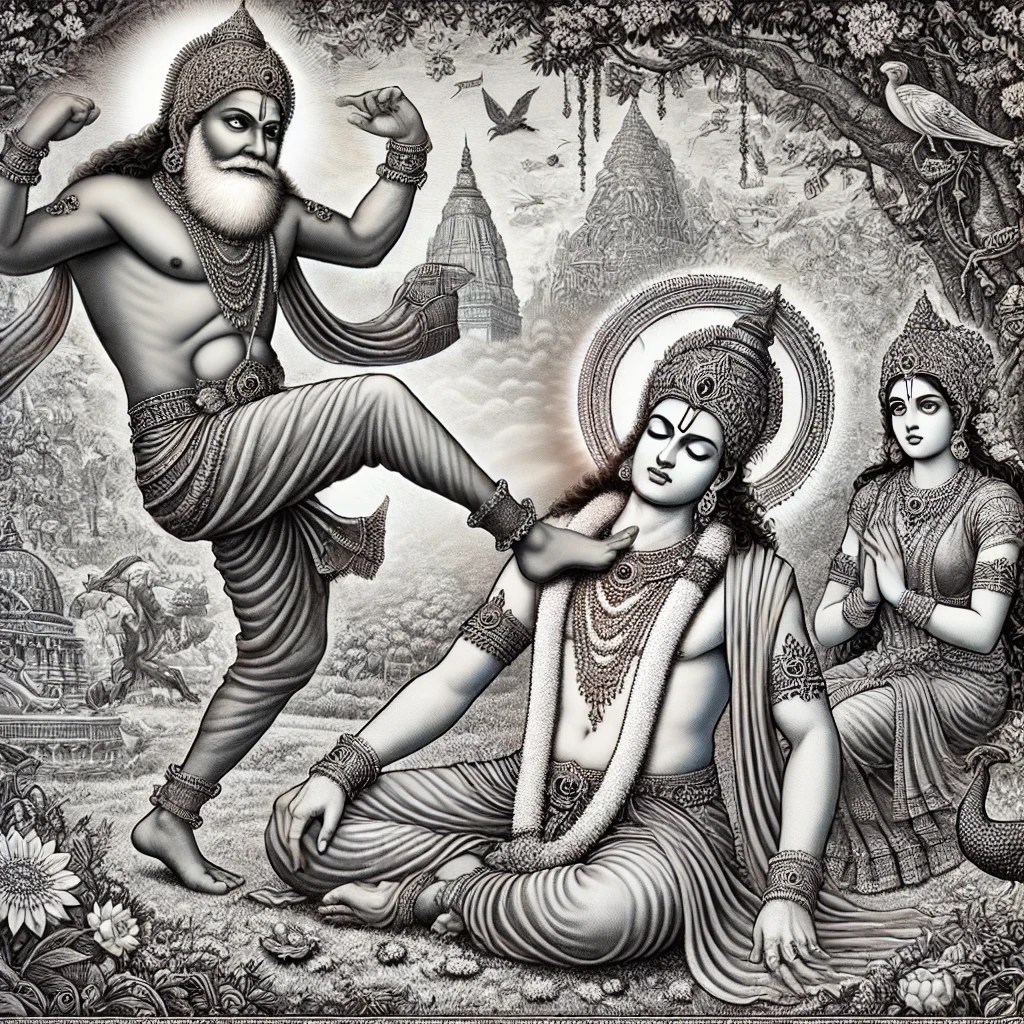
Now sages, though enlightened with immense wisdom, are known to have big egos and even bigger tempers. Angered by this perceived disregard, Bhrigu kicked Vishnu hard in the chest. In the very sacred space where Vishnu’s eternal consort, Goddess Lakshmi, resides.
The heavens gasped. The cosmos trembled. But Vishnu, ever the epitome of grace and tolerance, did not react in anger. Instead, he tenderly took the sage’s foot in his hands and massaged it, trying to sooth away any pain the kick may have caused.
Goddess Lakshmi watched – stunned, disbelieving. Her Lord, the mighty Preserver of the Universe, had just been insulted, and yet, instead of retaliating, he was showing concern for the very man who had dishonored her! The insult had not just landed on Vishnu’s chest; it had struck Lakshmi’s very essence.
Indignation – and sorrow – surged within her. If her honor meant so little to Vishnu, how could she remain in Vaikunth? Hurt to the core, Lakshmi left home. Heartbroken, she descended to Earth, vowing to undertake penance.
Without Lakshmi, Vaikunth was no longer home for Vishnu. Grief-stricken, he too followed her to Earth.
Thus began a timeless saga of love, separation, penance, and reunion—a tale that continues to captivate devotees even today.
*
On Earth, longing for his beloved, Vishnu wandered across mountains and rivers, through sacred forests and holy lands. His journey finally led him to the serene hills of Tirumala, where he sought refuge in an anthill beneath a tamarind tree. Days turned into weeks, weeks into months, as the Lord of the Universe waited, pining for his other half, living the life of a hermit.
In this state, he was known as Srinivas or ‘the one in whom Lakshmi resides.’ Concerned for Srinivas’s well-being, the gods arranged for Vakula Devi, a reincarnation of Yashoda (his foster mother from his Krishna avatar), to care for him.
*
But where was Lakshmi?
In the nearby kingdom of Narayanapuram. The king, Maharaja Akash Raj, had been ploughing a sacred field as part of a ritual when his plough unearthed a golden lotus. Nestled within its petals was an infant girl, glowing with divine brilliance. Being childless, the king and queen joyfully adopted her and named her Padmavati, meaning ‘one born of the lotus.’ The child was none other than Goddess Lakshmi, reborn on Earth.
Padmavati grew up to be a noble princess, unmatched in beauty, grace, and intelligence. Fate, however, had already scripted her reunion with Vishnu.
Years passed, and then, the inevitable happened. One day, Srinivas saw Padmavati playing with her friends in the forest. Mesmerized by her beauty, he fell in love instantly. Padmavati, too, felt an inexplicable connection with this mysterious yet familiar presence. However, her attendants mistook him for an intruder and drove him away. Disappointed but undeterred, Srinivas returned to his hermitage, longing for his beloved.
It was Sage Narada who revealed the truth – Padmavati was none other than Goddess Lakshmi herself. Encouraged by this divine revelation, Vakula Devi approached King Akash Raj and formally sought Padmavati’s hand in marriage on behalf of Srinivas.
When the king learned that Lord Vishnu himself wished to wed his daughter, he was overjoyed. Recognizing the sacredness of the match, he began preparations for a wedding unlike any other – a celebration truly worthy of the gods.
But grand weddings require grand wealth, and Srinivas, now a hermit, had none. To fund the wedding, Srinivas turned to Kuber, the treasurer of the gods, for a loan. Kuber, though initially hesitant, agreed under one condition—Vishnu must repay the debt in its entirety before returning to Vaikunth.
*
Thus, the celestial wedding of Srinivas and Padmavati took place with unmatched splendor. The earth rejoiced, the heavens showered flowers, and the mountains of Tirumala echoed with celestial music.
The divine couple were finally together, bound in the eternal bond of love.
Now, it was time for Vishnu and Lakshmi to return to Vaikunth. Yet, the divine debt remained unpaid. It was then that Vishnu assumed the sacred form of Lord Venkateshvara to stay behind in Tirumala, thus honoring his promise to Kuber.
To this day, Lord Venkateshvara stands in all his splendor atop the Tirumala hills, showering blessings upon those who seek his grace. Devotees continue to offer their prayers and contributions, believing they aid in repaying Vishnu’s eternal debt.
And who knows? Perhaps, one day, the celestial loan will finally be settled.



 Being Meeta